Dejan Koplić, 30, from the village of Deronje near Odžaci, is competing for Young Farmer of the Year, a title organized by 3Banka and Blic Biznis. His case is that dedicated work, modernization and a move to automated systems can lift a family business to the level of a leading agribusiness. He plans further spending on transport and automation, and he sees his life and future in the village.
After secondary school, Koplić did not want to enroll at university or leave his home place. The family flower business was expanding, and his wish to stay and improve production outweighed everything else. He inherited the business from his parents and then fully transformed and modernized it.
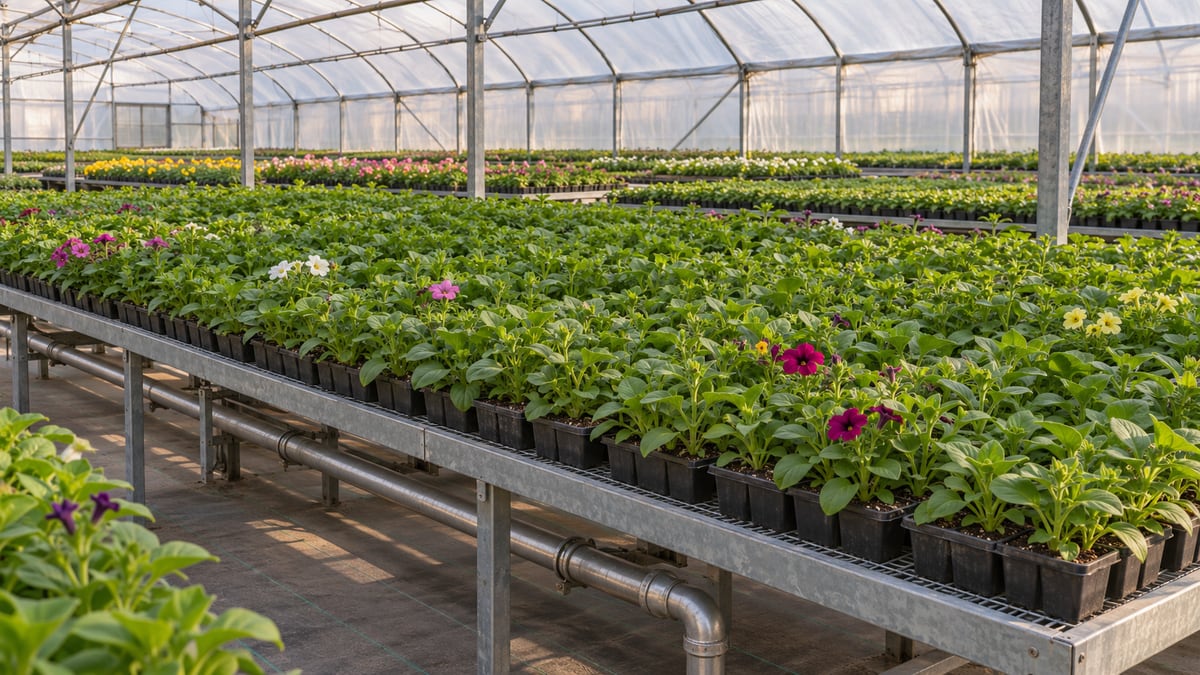
He now has 11 modern heated greenhouses in Deronje, covering between 2,500 and 3,000 square metres on the family's own land, and he produces 200,000 flower seedlings a year.
He recalls that the start was extremely hard and modest: two or three basic greenhouses, dark plastic film and primitive heating with soybean bales. The fire had to be kept going without a break, every hour. When winter set in and the outside temperature fell to minus 20 degrees, he, his father and his brother, when the brother came from university, sat through whole nights in turns. Water in the system sometimes froze, or a stove leaked. As soon as he took over, he decided to modernize everything, installing professional greenhouses with double film and automatic pellet stoves.
Heating is now computer-regulated, and the water temperature is kept constantly at 55 to 60 degrees, which he says gives the plants optimal growing conditions. Over the last five years he has also built a large connected greenhouse of 720 square metres with massive galvanized pipes. It holds heat on its own and allows work through the whole winter without going outside into the cold.
Worry about fuel never stops. Koplić says heating a greenhouse is like having a small baby: someone must be there all the time. Even with automatic stoves, an electronics fault can happen at 2 a.m. If a stove stops at minus 10 degrees, the entire production is lost, and he says there is no recovery from that loss.
The rise from 10,000 to 200,000 seedlings required constant investment that could not be paid for only from current earnings. He says that, at this pace, a grower cannot suddenly save a pile of money from his own pocket and put up three new greenhouses at once. Through 3Banka the family could borrow, build the structures and repay the funds over two or three years while they were already making a profit. He calls the bank remarkably fast. A few days ago, just before the season began, a stove leaked. Staff from 3Banka stepped in within two or three days, the money was available, and a new stove is already on the way. He says the bank has always met the farm's needs without paperwork complications.
The family also used provincial and state subsidies to buy greenhouses and boilers whenever that was possible.
Koplić runs the holding in Deronje himself and hires workers in season, while the family remains the pillar of the business. His brother is his greatest support and his main helper on the farm. His father and mother opened a sales space and an evergreen-tree nursery in nearby Odžaci, where they sell Dejan's flowers directly for 8 March and in the spring and autumn seasons. He says his brother helps a great deal and is the lead person on the farm. His mother does not work in the greenhouse: she and his father are in Odžaci with their evergreen nursery, selling both their own plants and his flowers when the season starts, so the farm does not pay an extra worker.
Besides retail, Koplić sells about 70 to 80 percent of production wholesale. He supplies public utility companies and green services in Sombor and Bačka Palanka, along with numerous regular distributors. The family owns arable land but decided to lease it out so he could devote himself entirely to flowers, because sowing and ploughing clash directly with the main peaks in flower sales.
Through the business, both Dejan and his brother have built their own houses. Koplić says both houses came only from flowers and their work.
Flower distribution cannot stop in season, so new vehicles are a priority. He says customers are waiting for the goods and a breakdown halfway cannot be afforded. He wants to replace two existing vans with newer or completely new ones so he can rely on them for years. He also plans to improve heating automation further and to hire two or three more workers.
The flower business brings heavy pressure from rising prices of production inputs, land and pots, but Koplić is sure about staying in the village and living out a dream he had as a boy. He says country life can be good, and he stands firmly by that: there is freedom, one's own yard and space, no city crowds, and the town is a short drive away if something is needed. In his view, anyone who wants to work can live well from rural work, while those who do not want to work only get by. His aim is to automate the business as far as possible so that he can later run it as the owner. He would like his children to continue it, but only on those sound, modern foundations, without the same back-breaking labour.