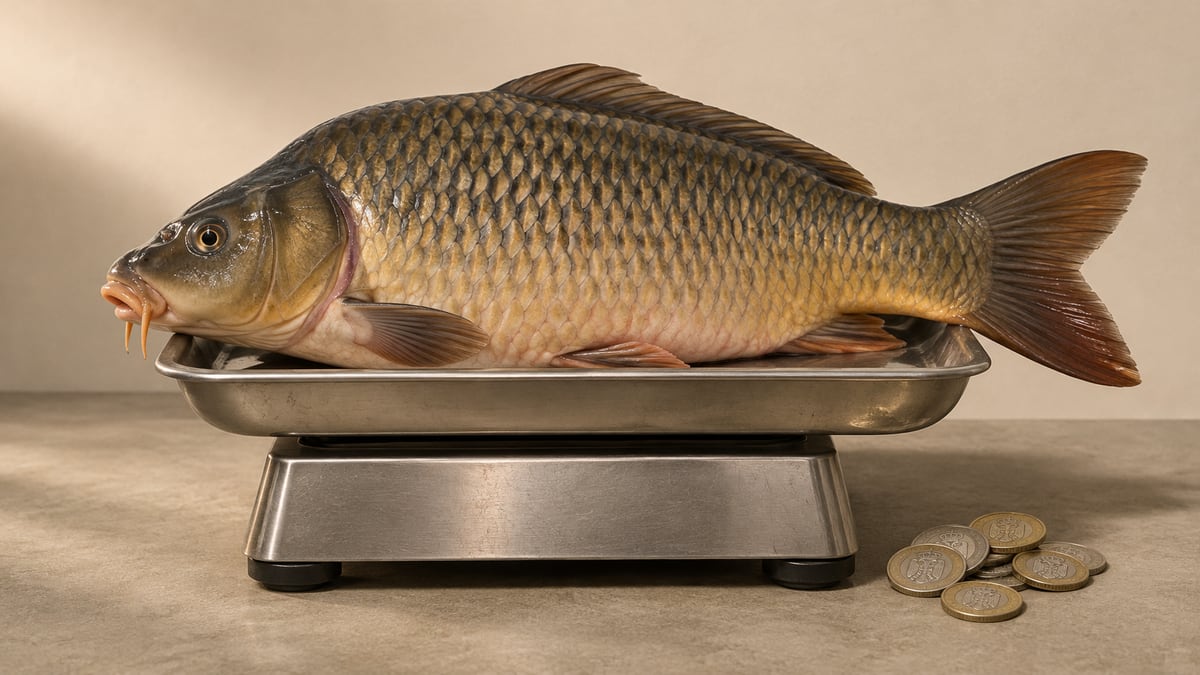
Carp, traditionally the fish most in demand for fasting slava tables, is 20 to 25 percent more expensive this year than last year. Ahead of the Christmas fast and Nikoljdan, the question is whether the domestic market will be adequately supplied with fish. The autumn catch is under way, but domestic production has been shrinking for years, and high costs of feed, energy and fuel are a further burden on producers. The current wholesale price of carp is about 550 dinars per kilogram excluding VAT. According to producer estimates, fish shops should charge 800 to 850 dinars, while large retail chains are somewhat lower at about 700 dinars, depending on promotions.
Krum Anastasov, director of the Kapetanski rit fish farm and president of the Fisheries Group at the Chamber of Commerce of Serbia, told Politika that problems in domestic fisheries are long-standing and that the rise in the carp price follows shrinking production as well as current market conditions. He said that what happened from the coronavirus period onward reduced both production and the area under fish ponds. At the same time, he said, every input from fish feed to energy and fuel has become drastically more expensive, so it is natural that the price of fish has risen. He added that carp is also in short supply in the region, where prices are high, and that the market has to accept this because any scarce good becomes more expensive.
Anastasov said the price increase is not the only problem facing this branch of agriculture. He described the years-long fall in production capacity as much more serious, and said that without solving it, market stabilization is hard to expect. The reasons are long-standing, he said, and a solution is needed to stabilize at least the production that exists now so that output does not keep falling. He stressed that carp is about 20 to 25 percent more expensive than last year and that production has also fallen. Asked what carp costs now, he said the average wholesale price is about 550 dinars per kilogram, with VAT charged on top.
Retail prices are considerably higher and differ by place of sale. Anastasov said the price in fish shops should be 800 to 850 dinars. In supermarkets it depends on whether promotions are running, but the standard price is about 700 dinars. He considers prices of 1,000 dinars and above perhaps a little excessive. He advises shoppers preparing for upcoming slavas and the Christmas fast to watch the origin of the fish as well as the price. In his account, large retail chains have an advantage in traceability, so a buyer can find out where the fish comes from. He said Serbia has very good carp production, above all in meat quality, and that he sees little reason to be very selective. Chains may be somewhat cheaper and also offer good product traceability, he said.
The greatest uncertainty concerns how much fish will be available during the coming holidays and winter months. Anastasov is not sure the domestic market can meet demand throughout the period of higher consumption. He said that at the end of last year’s Christmas fast fish became scarce, there was practically none, and imports then began. The price jumped sharply, and the shortage was also felt during the summer. His assessment is that the carp shortage is no longer limited to the peak holiday period and, because production has fallen, can extend through the rest of the year. A shortage of fish in the region at the same time makes it harder to top up domestic supply quickly with imports at more favourable prices.
Figures from the Statistical Office of the Republic of Serbia show how much prices differ from city to city. In the statistical review for mid-October, the most common price of carp was 930 dinars per kilogram in Belgrade, 1,050 in Novi Sad and 1,105 in Pančevo. At the same time a kilogram cost about 640 dinars in Niš, 700 in Subotica, 750 in both Kragujevac and Valjevo, and 800 in Zrenjanin. Shoppers can therefore pay very different amounts for the same species depending on the city and the place of purchase. For households preparing a slava table, that is a notable expense, especially when fish is bought in larger quantities.
Cheaper species are also on the market. From some producers, silver carp can be bought for about 350 dinars per kilogram and grass carp for 450, while a kilogram of trout in some retail chains costs about 700 dinars. At the beginning of November, catfish from one domestic producer cost 850 dinars and pike-perch 1,100 dinars per kilogram. Among sea fish, hake was available in some shops for about 450 dinars, while sea bass reached approximately 1,500 dinars. The wide range means the cost of preparing a slava table will depend heavily on the choice of fish and on whether it is bought directly from a producer, in a fish shop or in a large chain. Whether the fish is whole, cleaned or already prepared for serving can also make a significant difference to the final bill.
There are so far no reliable announcements of a further price rise immediately before the holidays. Domestic producers warn that the multi-year fall in production needs to be stopped. Otherwise, the shortage of carp on the market could become more pronounced and supply more dependent on imports. Anastasov says the most important task is to find a way to preserve existing fish farms and stabilize production, because without enough domestic fish, long-term price stability is also hard to expect.