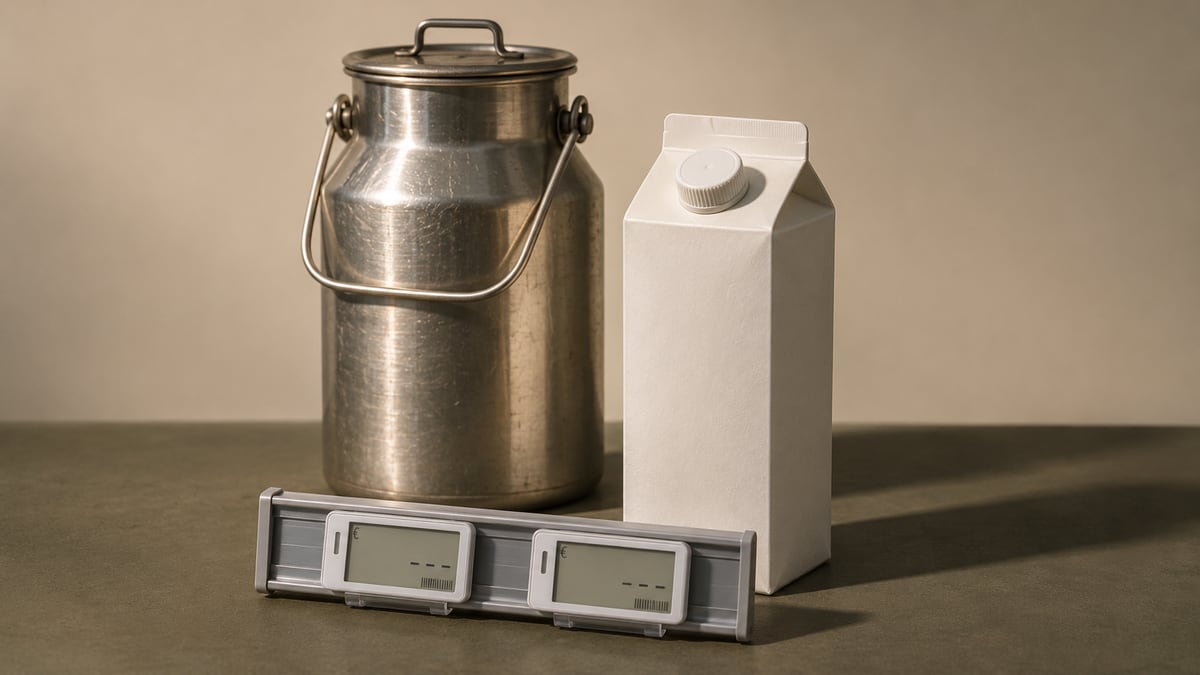
A price on a supermarket shelf for a litre of milk, a kilogram of sugar or a pack of coffee may reflect more than the purchase cost, transport and the retailer's margin. Software can weigh demand, competition, stock, the weather and even the moment a shopper arrives. The further question is whether a retailer can estimate how much someone is willing to pay before that person decides to buy.
Artificial intelligence, electronic shelf labels and analysis of consumer behaviour are gradually changing how retail prices are set. There is a difference between technology that helps a store run its business and technology that extracts the highest price a shopper will accept.
For decades the basic retail model was relatively simple: the trader bought a product, added operating costs and a margin, and displayed a price the customer could accept or reject. Prices were not wholly static. Supermarkets ran promotions, seasonal reductions, weekend offers and markdowns on goods nearing their use-by date. Newer software can do something more complex. An algorithm can analyse thousands of products at once, follow competitors' prices, forecast sales and recommend price changes much more often than a manager deciding on discounts once a week. That system is called dynamic pricing. The principle is familiar from airline tickets and hotels, where the same service can change in price with demand, available capacity and the time of purchase. Similar logic, with some differences, is now being applied to everyday consumer goods.
A supermarket that records higher Friday-afternoon sales of milk, bread, meat and other staples could see an algorithm recognise the pattern and propose a price change. Electronic shelf labels make such changes possible without replacing paper tags by hand. That does not mean supermarkets automatically make milk more expensive at the busiest time. An electronic label is not itself proof of a dynamic price rise. The same technology can be used to cut prices faster, match competitors or reduce food waste. Meat approaching its use-by date, for example, can be automatically proposed for a markdown, limiting the store's losses and offering the shopper a cheaper product. The problem arises if the algorithm is given a different task: finding the highest price the market will accept. Technology then stops being only a tool for more efficient business and becomes a way to exploit shoppers' willingness to pay.
Modern retail chains hold large amounts of purchasing data. Loyalty cards, mobile apps, online shops and digital coupons make it possible to analyse how often people buy, which products they prefer, the average value of a receipt and how they respond to discounts. From that, a retailer can estimate whether a consumer regularly buys a brand, how sensitive that person is to price changes and which discount would most likely prompt a purchase. This matters especially for habitual goods. Someone who has used the same coffee, detergent or type of yoghurt for years may switch brands less often even when the price rises. A shopper who regularly looks for promotions may instead be offered personalised coupons. Personalised discounts are already common in loyalty programmes. Individually raising the basic price raises more serious questions of privacy, transparency and consumer protection, including whether two shoppers should receive different offers for the same product because an algorithm judges their habits differently.
For farmers, the article treats the distribution of any extra money as the central question. Imagine a milk producer selling a litre of raw milk to a dairy at an agreed purchase price. The dairy processes, packs and delivers it to a retail chain, which then sells it to the consumer. If a supermarket algorithm judges that the retail price can rise, that does not mean the raw-milk producer will receive more. The purchase price can stay unchanged while the additional revenue remains somewhere else in the supply chain. The same question applies to apples, potatoes, meat, sugar and other agri-food products. Technology that optimises retail prices does not guarantee a fairer split of income among producers, processors and traders. If large retail systems have much better demand data than their suppliers, their bargaining position can grow stronger. That raises the question of whether the digitisation of trade makes the market more efficient or deepens the imbalance between those who produce food and those who sell it.
Not every use of algorithms harms consumers. A well-designed system can reduce storage costs, prevent shortages, improve purchasing plans and help perishable food sell before it is thrown away. Those gains can benefit both retailers and shoppers. Algorithms can also be set to maximise profit. If several retailers use systems that follow competitors' prices and react automatically, prices can become aligned without a classic agreement between companies. Under specific conditions, some automated pricing models can weaken price competition. Competition authorities, as well as programmers and retailers, are dealing with the issue. In a digital economy it matters not only who decides a price but under what rules the software decides it.
Serbia's food market has for years been marked by debates over trade margins, the position of suppliers, purchase prices and the strength of large retail chains. Bringing advanced algorithms into that setting opens a further dimension. The open questions are whether a retailer who can forecast demand precisely will use that advantage to lower costs and prices or to increase profit; whether food producers will have access to data that helps them plan production; and whether consumers will know when an automated system is influencing a price. The growing role of digital technology should not be lost in the discussion of unfair trading practices. Rules on relations between traders and suppliers, competition, consumers and personal data have different tasks, and no single law can resolve every challenge of algorithmic pricing. Institutions will need the technical knowledge to supervise modern retail systems.
The largest change from artificial intelligence is not that a price can change faster. It is that a retailer can predict shopper behaviour more precisely. A seller once had to guess how many people would buy a product at a given price. Software can now analyse a huge number of past transactions and keep refining its forecasts. That can lead to more efficient trade, smaller losses and a better offer. It can also create a market in which the shopper knows less about how a price is formed while the retailer knows more about that shopper's habits. The supermarket of the future may not have more expensive products, but it will know better how much people are willing to pay. For farmers, a further dilemma remains: if digital technology makes it possible to earn more from the same product, who receives the extra money — the producer, the processor, or the algorithm-led retail system that discovered what the shopper would pay? The article suggests that this may be one of the most important questions for the future of food trade, because what is in the basket may matter less than how well the system knows the person pushing it.