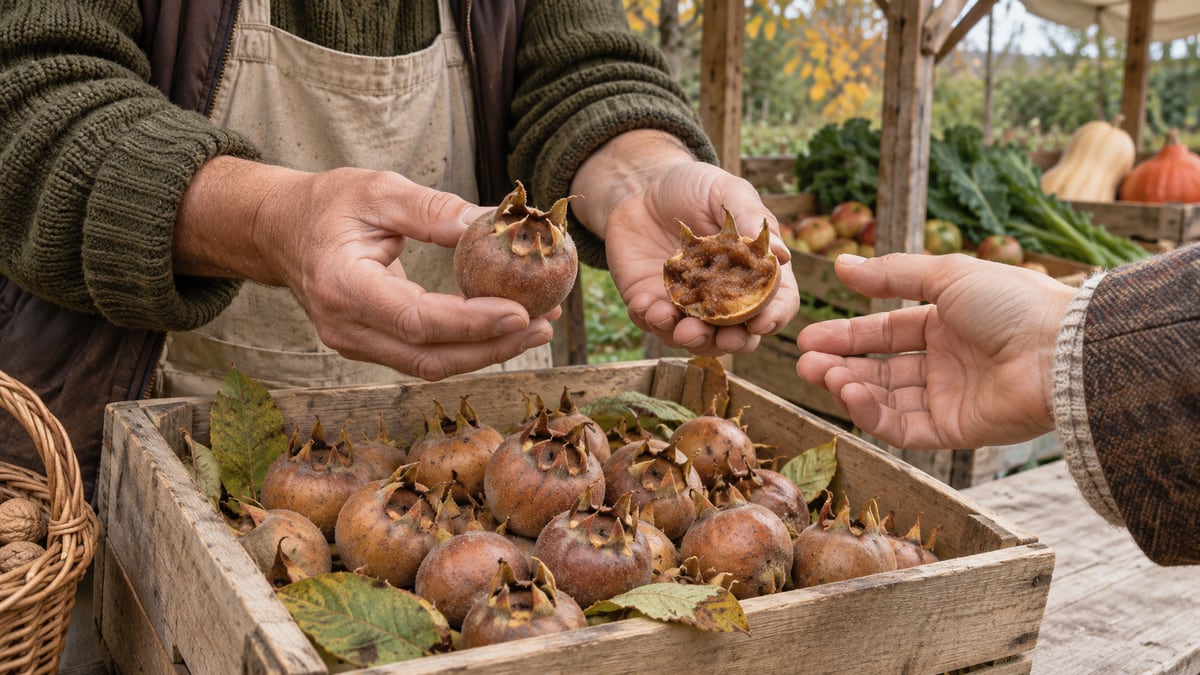
On the Stanković family farm in Mali Požarevac, the growers did not look for a fruit they could produce in the largest quantities. They looked for something buyers would remember. They found medlar, an old and almost forgotten fruit that was once common in yards and is now rarely seen even at markets.
Ilija Stanković considers their planting one of the few larger medlar orchards in Serbia, if not the only one. The idea was not to replace peach, plum or sour cherry, but to give the farm a recognisable product and open the door to customers. He says they wanted to be different and to have something others do not, so people would know them for medlar and then also buy peaches, plums and sour cherries. They do not want to put fruit in a crate and take it away without knowing who tasted it and whether they liked it. They want a direct relationship with the buyer and a product that has its own story.
The family grows several fruits. Peaches, plums, medlars and sour cherries are the most widely grown, and they also have a smaller area under vines. In recent years they have turned more toward old peach varieties whose fruit has a stronger taste, aroma and juiciness.
Medlar is harvested in October and sold in November. For most of the year it does not require much work. They apply basic fertiliser and foliar feeding, remove dry branches and do corrective pruning where branches cross or hinder the crown.
The most sensitive work begins only after the harvest. The fruit is not picked fully ripe, but while it is still firm and green. It is then carefully placed in crates and left to ripen. Ilija says medlar is not complicated to grow and needs little work until picking, but there is more work afterwards. The fruit must be laid in a thin layer so it is not crushed. Once or twice a week, depending on the outside temperature, they sort it, set aside the fruit that has ripened, pack it and send it to buyers.
This year’s harvest is planned for around 15 October. The medlar will then ripen in storage for about 15 days, and the first ripe fruit is expected on the market in early November. That timing is one of its advantages. It reaches the market when the supply of fresh domestic fruit is already much smaller and buyers are looking for something other than apples and pears.
Ivana Stanković, a teacher of Serbian language and literature, grew up in the orchards and is one of the four family members who work on the farm. She says they often have to explain to younger buyers what medlar is and when it is eaten. Fruit just picked from the tree is firm and not ready to use. Only after it has stood does it become soft and juicy and take on its characteristic taste. She says young people rarely encounter medlar and most often see it for the first time at the family’s market stall. When it ripens, the inside becomes soft and resembles the contents of jam. The fruit has several stones that are not eaten. They explain how to use it and when it is ripe enough, and she says many people come back after they taste it.
Buyers come from different generations. Older people remember medlar from childhood, while younger people and families with children come out of curiosity and a wish to try fruit they do not often see.
From the Stanković family’s experience, interest in fresh medlar is growing from year to year. Supply is small, so the price is more favourable than for fruit species that reach the market in large quantities in the same period. Ilija says there are wholesale and retail buyers, older people who know the fruit well and young people who want to try something new. He says medlar is slowly coming back into fashion, and that a buyer will try it if the offer and the product’s story are explained well. Putting a crate on the stall is not enough if people do not know what is in it.
Besides selling fresh fruit, the family began experimenting a few years ago with medlar brandy. For now they process between 10 and 15 percent of the crop, and they plan to raise that share gradually. Fermentation is slow. Pomace prepared in autumn does not have to be distilled immediately. It can wait until March or April, after the coldest winter days, when the farm has fewer urgent jobs. Ilija says the brandy is made in a similar way to brandy from other fruits, but medlar fermentation lasts longer. If they prepare the pomace in autumn, they leave distillation for March or April, which suits them because they do not have to distil in the middle of winter. From a 100-litre still they obtain about 10 litres of brandy.
The long-term plan is to send a larger part of the crop into processing. That would extend the life of the product and avoid having to sell the entire quantity of fresh fruit in a short period.
Medlar also suits people who cannot be in the orchard every day, but Ilija warns that this is not a reason to enter production unprepared. He would recommend it to those who lack time for more demanding fruit species, but only after they have thoroughly researched production and the market. Before planting any orchard, he says, a grower must know what is being planted, how the plants will be cared for and who will buy the fruit. A species should not be chosen without prior knowledge merely because it is rare.
Ilija, Ivana and their parents work on the farm. They do not hire seasonal workers, so they adapt the size and structure of production to what the four of them can do well. Their work in fruit growing began long before Ilija and Ivana chose their professions. Ivana says they grew up in the orchards. At three or four they went with their parents and first carried empty crates. Later they could carry an occasional full one, then they began picking, taking fruit to cold stores and meeting buyers. They also sell at Zeleni venac, where they have had a stall for a long time. She says it is not that a Serbian-language teacher moved into fruit growing. It is closer to the truth that a fruit grower became a teacher.
Family labour sets a natural limit on expanding the area. The Stanković family does not want to increase production at any cost if that means losing quality or control over sales.
Their parents established the first three orchards in uncertain times so the children could be educated. One of those old orchards has now been cleared because the trees had reached the end of their productive life. For Ilija, that is the end of a period in the family’s history. He says this is the third orchard their parents planted so that he and his sister could go to school. Clearing it closes one stage in the farm’s development. In about a month they will plant a new peach orchard on the same site and begin another stage. They want to modernise production, install anti-hail nets and secure water for irrigation.
Peach of the Fayette variety will be planted where the old plums stood. The young trees are already prepared, and the whole replacement was planned a year and a half ahead, while the old orchard was still bearing. Ilija says they are beginning to work as a more serious farm that plans steps several years ahead. They do not want to decide today for tomorrow. If they know when an orchard will end its productive life, they must prepare young trees, land and money for the next one earlier.
The family still has about two hectares of plum in production, mostly the varieties Čačanska rana and Čačanska lepotica. They chose Čačanska rana because the orchard’s position allows earlier ripening and a market entry when the price is more favourable. The old orchard they removed consisted of Čačanska rana and Čačanska najbolja. The trees had aged, and heavy crops and weaker branch strength led to breakage, so further maintenance was not economically justified.
The family is also renewing two more peach orchards at the same time. They are turning to older varieties that can offer what Ilija keeps calling their main advantage: fruit with a recognisable aroma and taste at the moment of harvest. He says they want a peach the buyer can pick or buy ripe and smell immediately. They do not want fruit that must wait for days to gain flavour. Their areas are not large, so they cannot compete on quantity. They can offer variety, ripeness and quality that bring the buyer back.
The lack of rainfall is also visible in their orchards. Some trees have begun to dry out, and the plantings are for now maintained without an irrigation system. The next large step will be to examine the possibility of drilling a deep well, installing irrigation and raising anti-hail nets. The depth at which water can be found depends on the specific site, so the final decision will be made after the ground is surveyed.
In previous years the family used available subsidies to buy machinery. They bought a tractor and a field sprayer, and they say they will keep following public calls in order to speed up modernisation.
Ilija is a plant-protection engineer by training and also a poet. He has published one book and is preparing a second. He says fruit growing has not separated him from poetry. The quiet among the trees prompted him to write. He has worked in fruit growing since he learned to walk, and he became a poet because of the calm he finds in the orchards. His poems are mostly love lyrics. Among the trees, he says, thoughts clear and words come by themselves. He thinks fruit growing produced the poet in him. Asked whether medlar brandy also helps inspiration, he answers with a smile that after a few small glasses a new line might appear. The orchard remains the greatest inspiration.
Beside the old orchard that was cleared stands a vineyard planted in 1999. Ilija was six then and remembers running after his parents and helping them plant the vines. He says that vineyard is his first memory of agriculture: on one side the place where everything began, and on the other the plot where they are establishing a new, more modern orchard. On the same spot, he says, they can see two beginnings of the farm.
As a member of the association Farmers of the New Generation, Ilija exchanges experience with producers from Serbia and other countries. Education, specialist trips and timely information on subsidies, he says, allow small farms to achieve better results on limited areas.
The Stanković family therefore does not see its future in a sudden increase in production. Their path is rare and old fruit species, quality the family can control itself, direct sales and gradual modernisation. Medlar serves as a mark of recognition. A buyer comes to try a fruit that can hardly be found anywhere else, and then meets the farm’s other products. In that way a forgotten fruit becomes the start of a contemporary business idea.
The text was produced within the project Who Feeds Belgrade: the path of food from producer to the city table, co-financed by the City of Belgrade Secretariat for Information. The views in the text do not necessarily reflect those of the body that awarded the funds.