The Belgrade fruit and vegetable market was mostly well supplied from the end of October to mid-November 2026, but prices of some products changed markedly. The clearest case was tomato, whose dominant price at the Belgrade wholesale market rose by 100 dinars per kilogram in the last observed period. Across all three observations, cabbage, potatoes and onions kept the same prices at the Kalenić and Skadarlija green markets.
The review uses three consecutive bulletins of the Agricultural Market Information System of Serbia (STIPS), covering 26 October to 15 November 2026. For Belgrade, prices at the wholesale market were compared with Kalenić and Skadarlija. Every price below is in dinars per kilogram.
At the end of October, STIPS reported that favourable weather had contributed to a good supply at the wholesale market, while sales were somewhat slower. The next bulletin rated supply at Skadarlija as solid. In mid-November there were enough apples at the wholesale market, and reporters recorded no significant change in the vegetable offer compared with the previous observation.
Demand is described most concretely for the end of October, when reporters noted slower sales. The bulletins do not state quantities sold, so the price changes do not show whether buying strengthened or weakened in the first half of November. A good supply of apples alongside higher wholesale prices for some varieties shows that a supply rating alone does not explain why a price changed.
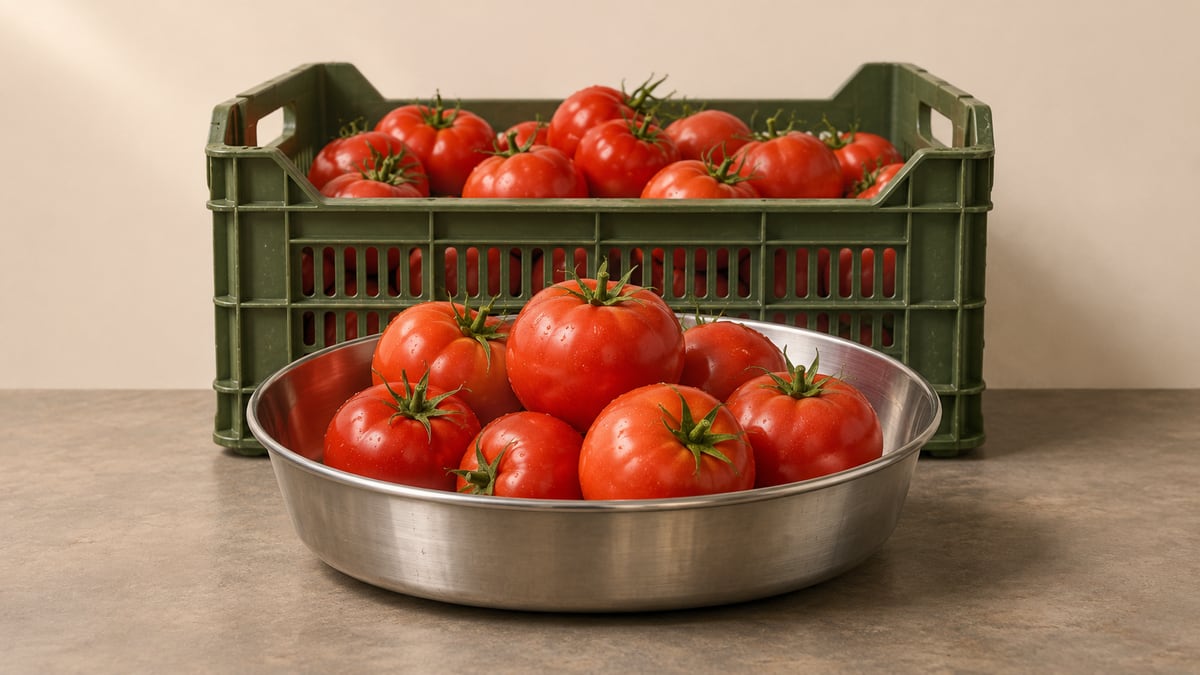
Tomato at the Belgrade wholesale market cost 160 dinars at the end of October, 150 at the next observation and 250 in mid-November. The jump between the last two observations, over seven days, was about 67 percent. At Kalenić the dominant price was 300 dinars all three times. At Skadarlija it rose from 250 to 350 and then fell to 300. In the same period in which wholesale tomato rose by 100 dinars, it became 50 dinars cheaper at Skadarlija.
Zucchini were more expensive at all three outlets by the end of the period. At wholesale the price fell from 130 dinars to 120 and then rose to 150. Compared with the end of October, it rose from 250 to 300 dinars at Kalenić and from 200 to 300 at Skadarlija.
Pepper prices depended heavily on the variety and the place of purchase. Šilja pepper at wholesale fell from 200 dinars to 150 and then returned to 170. In mid-November it cost 250 at Kalenić and 150 at Skadarlija. Babura pepper was 250 dinars at both green markets in that same mid-November period.
Cabbage cost 100 dinars at both Kalenić and Skadarlija in all three observations, although at wholesale it fell from 60 to 50 dinars. Potatoes moved in a similar way: the wholesale price fell from 90 to 80 dinars, while the green-market price stayed at 200 dinars at Kalenić and 150 at Skadarlija.
Onions were 50 dinars at wholesale throughout, 200 at Kalenić and 150 at Skadarlija. White beans also kept the same dominant price in all three observations: 300 dinars at wholesale and 500 at each green market.
Differences were especially visible in mid-November for salad cucumber and garlic. Cucumber cost 400 dinars at Kalenić and 200 at Skadarlija. Garlic was 900 at Kalenić and 600 at Skadarlija. Those comparisons show how far the dominant price of the same item could differ from one market to another. Calculating sellers’ earnings would require data on purchasing, the quality of the goods and selling costs.
At wholesale, Golden Delicious cost 80 dinars in the first two observations and 120 in mid-November, a rise of 50 percent. Idared went from an initial 80 dinars to 90, while other varieties rose from 110 to 120 dinars. At Kalenić and Skadarlija, Idared and Golden Delicious cost 250 dinars in all three observations. Other apples stayed at 300 dinars at Kalenić throughout, while at Skadarlija they rose from 250 to 300 and held that price.
Among southern fruit, lemons and mandarins moved in opposite directions. Lemons at wholesale gradually became cheaper, from 140 to 120 dinars, while mandarins rose from 150 to 170. At Skadarlija both lemons and mandarins cost 250 dinars throughout. Pomegranates at wholesale first rose from 250 to 270 dinars and then fell to 200. At both green markets they cost 350 dinars in mid-November, compared with 400 at the end of October.
The largest differences shoppers could see were in grapes. In mid-November, white grapes in the group of other varieties cost 350 dinars at Kalenić and 500 at Skadarlija. At the end of October the relationship was reversed, with 500 dinars at Kalenić and 250 at Skadarlija.
The three bulletins show that supply in the observed part of the Belgrade market was mostly stable, with price changes concentrated on particular items and outlets. Cabbage, potatoes, onions and white beans had predictable prices at the green markets, while tomato, pepper, cucumber and grapes could cost noticeably different amounts depending on the market and the week.
The figures come from the STIPS Fruit and Vegetables bulletins, issues 44, 45 and 46 of 2026.
The text was produced within the project Who feeds Belgrade: the path of food from producer to the city table, co-financed by the City of Belgrade Secretariat for Information. The views in the text do not necessarily reflect those of the body that awarded the funds.