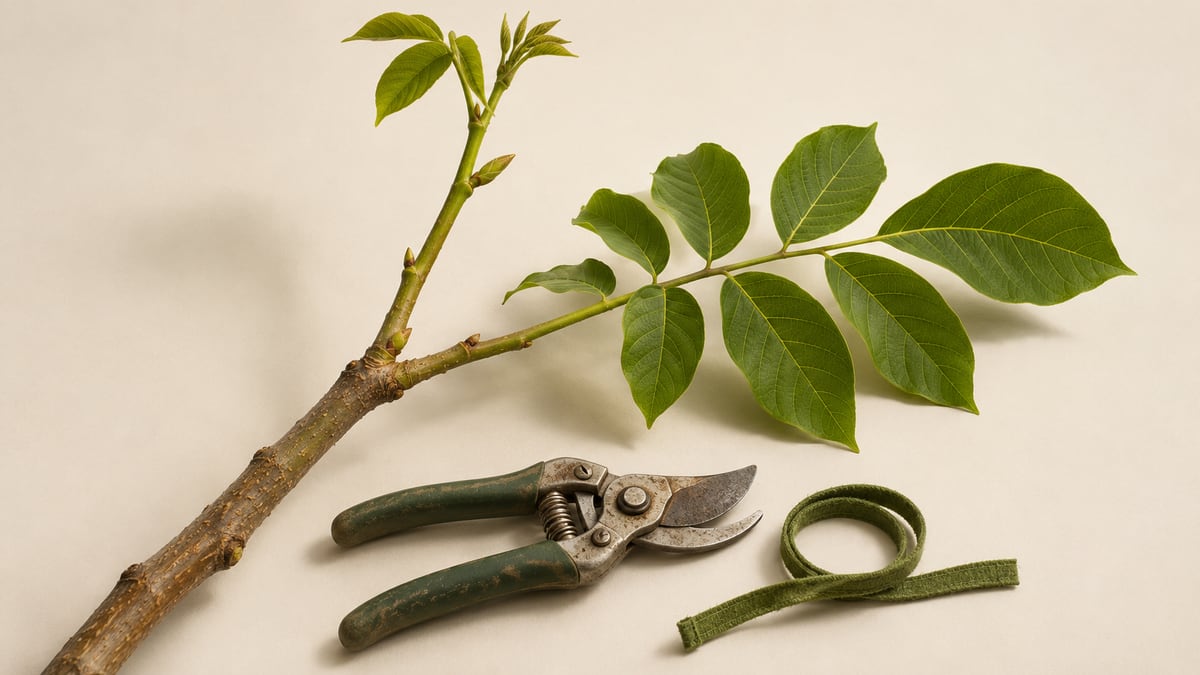
Walnut can crop for decades, but a long life does not mean a tree keeps a high, good-quality yield throughout that life. Modern production needs a different pruning approach from the one used for decades in traditional orchards, where trees were often left to develop naturally. The training form, proper formation of fruiting branches and enough light inside the canopy decide how long and how well trees stay productive. Growers also need to know the traits of lateral-bearing varieties, which are used more often in intensive production.
In commercial orchards the recurring question is how to match tree vigor, planting density and pruning without harming bearing. Planned canopy formation begins in the first year after planting. On lateral-bearing varieties a significant share of the crop forms on lateral buds of one-year shoots. That trait has allowed denser systems, with more trees per hectare, earlier cropping and mechanized orchard maintenance. Higher density also requires more precise control of growth and bearing. If the crown is formed poorly, neighboring trees shade one another, fruiting twigs develop weakly and the crop gradually moves to the edge of the canopy.
Variety and planting density have to be chosen together, because cultivars differ in vigor and in how they build fruiting wood. For less vigorous varieties such as Lara, Chandler and Fernor, on soils of medium fertility, the recommended spacing is eight meters between rows and four to six meters in the row. On more fertile soils, where vegetative growth is stronger, the in-row spacing rises to six to eight meters. More vigorous varieties such as Tulare and Franquette need more room: eight meters between rows and eight to ten meters in the row.
Dr Dejan Marinković of PSSS Belgrade gives these figures as recommendations for modern walnut orchards. The first value is the distance between rows and the second is the distance between trees in the row. The final choice also depends on water availability and the planned training form. On deep, fertile, well-supplied soils a walnut grows a stronger tree, and the wrong density can close the space between rows quickly. Once neighboring crowns touch and overlap, less light enters and it becomes harder to form good fruiting wood inside the canopy. At planting, the final size of the tree should be planned, not only the space a young plant needs in the first years.
Those first years set the future shape of the tree. The aim is a strong central axis and well-spaced lateral branches that will later carry the crop. Modern production uses free and structured central-leader forms, while the vase form is still common in many commercial orchards.
With a free leader, the central trunk is extended with minimal heading and the laterals are arranged in tiers, giving a roughly conical crown that is wider at the base and narrower at the top. That layout lights the lower canopy better and spreads fruiting branches more evenly. Laterals should not grow at too sharp an angle to the central axis, because they compete with the main trunk and can later become mechanically weak points. In young orchards, bending changes their position and encourages fruiting wood. On vigorous trees bending can begin in the first year, most often in July and August, on single branches or on whole tiers, depending on growth strength. That reduces the need for later heavy cuts, which can cause excessive vigor and delay the balance between growth and cropping.
A free leader suits deep, fertile soils with a good water supply, where trees can keep developing. If the central axis grows normally it is not headed, and laterals are directed so they do not compete with it. Well-placed branches higher than about 1.8 to two meters can be left unheaded, because they form an important part of the future bearing surface. The branches removed first are overly vigorous ones with sharp crotch angles that cannot be directed by bending.
A structured leader suits semi-upright varieties and soils of average fertility, where the canopy grows more moderately. Scaffold branches are set in a spiral along the central axis, preferably in line with the rows, so the planting gradually resembles a hedge and mechanized cultivation and maintenance are easier. In the early years, well-positioned laterals are encouraged while an overly dense crown is prevented. Pinching young shoots, especially at the end of June, by removing the tips of some shoots, can influence how they branch further.
The vase and its modifications still have a significant place even as intensive orchards rely more on central leaders. An open center lets in more light and makes fruiting branches easier to reach, but forming a vase takes patience. In the first years after planting, well-distributed primary branches are chosen as the skeleton. Their position has to spread the crop load evenly and leave room for secondary branches. In later years the center must be kept from closing. If many upright branches develop, the open form gradually loses its advantage. Where harvest is mechanized, the height of the primary branches, passage for machinery and the layout of the scaffold also have to be considered.
The text was produced within the project Who feeds Belgrade: the path of food from producer to the city table, co-financed by the City of Belgrade Secretariat for Information. The views expressed do not necessarily reflect those of the body that awarded the funds.